Tag: AI

  • How to Manage Your WordPress Blog from Cursor Using MCP

    How to Manage Your WordPress Blog from Cursor Using MCP

    I just published a blog post to my WordPress site without ever opening wp-admin. No browser tab. No Gutenberg editor. I wrote the content in Cursor, told my AI agent to publish it, and it did — complete with categories, tags, and proper formatting.

    This isn’t a hack or a workaround. WordPress now has official MCP (Model Context Protocol) support, which means any AI agent — Cursor, Claude Code, Codex, Gemini CLI — can interact with your WordPress site programmatically. Create posts. Upload media. Manage plugins. Moderate comments. All from the same interface where you write code.

    Here’s how I set it up and why it’s worth doing.

    Why Bother?

    If you already use AI agents for coding, you know the flow: you describe what you want, the agent writes it, and you review. But the moment you need to publish something to WordPress, you break out of that flow entirely. Open a browser. Log in. Navigate to the editor. Paste content. Format it. Add categories. Hit publish.

    With MCP, the agent handles all of that. You stay in your IDE. The content goes from draft to published without a context switch. And it’s not just posts — you get full access to your WordPress admin capabilities.

    The Stack

    Three WordPress plugins and one MCP client configuration. That’s the entire setup.

    ComponentWhat It DoesSource
    Abilities APIWordPress core framework for declaring machine-readable capabilitiesGitHub
    MCP AdapterBridges WordPress abilities to the MCP protocol so AI agents can discover and call themGitHub
    MCP Expose AbilitiesRegisters 61 core WordPress abilities (posts, pages, media, plugins, users, comments, menus, options)GitHub
    MCP client configConnects your AI agent (Cursor, Claude Code, etc.) to the WordPress MCP server via HTTPYour ~/.cursor/mcp.json

    The Abilities API and MCP Adapter are official WordPress packages, maintained by the WordPress core team. MCP Expose Abilities is a free, open-source plugin by Devenia that registers the actual content management abilities.

    Setup: WordPress Side

    Step 1: Install the Plugins

    Go to your WordPress admin (your-site.com/wp-admin) and install these three plugins in order:

    1. Abilities API — download from GitHub releases, upload via Plugins → Add New → Upload Plugin, then activate
    2. MCP Adapter — download from GitHub releases (v0.4.1), install the same way, activate
    3. MCP Expose Abilities — download from GitHub releases, install, activate

    The order matters. Abilities API provides the foundation, MCP Adapter bridges it to MCP, and MCP Expose Abilities registers the actual WordPress capabilities.

    Step 2: Create an Application Password

    The MCP client needs to authenticate with your WordPress site. WordPress Application Passwords are the cleanest way to do this.

    1. Go to Users → Your Profile
    2. Scroll down to the Application Passwords section
    3. Enter a name like cursor-mcp
    4. Click Add New Application Password
    5. Copy the generated password — you only see it once

    This password is scoped to API access only. It can’t be used to log into wp-admin directly, which is a nice security boundary.

    Setup: Cursor Side

    For remote WordPress sites, the connection goes through @automattic/mcp-wordpress-remote, an official proxy package that handles the HTTP transport.

    Add this to your ~/.cursor/mcp.json inside the mcpServers object:

    "wordpress-blog": {
      "command": "npx",
      "args": [
        "-y",
        "@automattic/mcp-wordpress-remote@latest"
      ],
      "env": {
        "WP_API_URL": "https://your-site.com/wp-json/mcp/mcp-adapter-default-server",
        "WP_API_USERNAME": "your-username-or-email",
        "WP_API_PASSWORD": "your-application-password"
      }
    }

    Replace the URL, username, and password with your actual values. Restart Cursor to pick up the new MCP server.

    What You Get: 68 WordPress Abilities

    Once connected, you can ask your agent to discover what’s available. Behind the scenes, it calls the mcp-adapter-discover-abilities tool and gets back a full inventory. Here’s what MCP Expose Abilities registers:

    CategoryAbilities
    ContentList, get, create, update, delete, patch, search posts & pages; manage revisions, categories, tags
    MediaUpload (from URL), get, update, delete media items
    PluginsList, upload, activate, deactivate, delete plugins
    MenusList, create menus; add, update, delete items; assign locations
    UsersList, get, create, update, delete users
    CommentsList, get, create, reply, update status, delete comments
    OptionsGet, update, list site options
    SystemSite info, environment info, debug log, toggle debug mode, transients

    There are also 12 optional add-ons for Elementor, Rank Math, Wordfence, Cloudflare, GeneratePress, and more — install only the ones your site uses.

    Using It in Practice

    Here’s what it looks like in a real session. I asked my Cursor agent to publish a blog post I’d just drafted. It:

    1. Called content/list-categories to find the right category ID
    2. Created 5 new tags via content/create-tag
    3. Called content/create-post with the full HTML content, category, and excerpt
    4. Called content/update-post to attach the tags

    The post was live as a draft in under 10 seconds. I reviewed it in wp-admin, made one formatting tweak (which I also did via MCP), and published.

    The agent calls look like this under the hood:

    // Discover what's available
    mcp-adapter-discover-abilities {}
    
    // Create a post
    mcp-adapter-execute-ability {
      "ability_name": "content/create-post",
      "parameters": {
        "title": "My Blog Post Title",
        "content": "<!-- wp:paragraph -->n<p>Your content here...</p>n<!-- /wp:paragraph -->",
        "status": "draft",
        "category_ids": [6],
        "excerpt": "A short description of the post."
      }
    }
    
    // Create and assign tags
    mcp-adapter-execute-ability {
      "ability_name": "content/create-tag",
      "parameters": { "name": "AI" }
    }

    Tips and Gotchas

    Use Gutenberg Block Markup

    If you send raw HTML, WordPress will render it but your theme’s block styles won’t apply. For proper formatting, wrap content in Gutenberg block comments:

    <!-- wp:paragraph -->
    <p>Your paragraph text here.</p>
    <!-- /wp:paragraph -->
    
    <!-- wp:code -->
    <pre class="wp-block-code"><code>your code here</code></pre>
    <!-- /wp:code -->
    
    <!-- wp:heading -->
    <h2 class="wp-block-heading">Your Heading</h2>
    <!-- /wp:heading -->

    This is what the Gutenberg editor produces internally. If you tell your agent to use this format, your posts will look identical to ones created in the editor.

    Draft First, Publish Later

    Always create posts with "status": "draft" so you can review before publishing. You can then either publish from wp-admin or tell the agent to update the status:

    mcp-adapter-execute-ability {
      "ability_name": "content/update-post",
      "parameters": {
        "id": 48,
        "status": "publish"
      }
    }

    The Abilities API Is Now in WordPress Core

    As of WordPress 6.9, the Abilities API has been merged into core. If you’re on 6.9+, you may not need the separate Abilities API plugin. The MCP Adapter and MCP Expose Abilities plugins are still required as separate installs.

    Beyond Blog Posts

    The real power isn’t just publishing posts faster. It’s having your entire WordPress site accessible as part of your AI workflow. Some things I plan to use this for:

    • Batch content updates — update metadata, fix formatting, or patch content across multiple posts in one session
    • Plugin management — check plugin status, activate/deactivate, or upload new plugins without leaving the IDE
    • Comment moderation — review and respond to comments as part of a daily routine, all from the terminal
    • Site diagnostics — check debug logs, site info, and environment details when troubleshooting
    • Content pipelines — research a topic, draft in Obsidian, review, then publish to WordPress — all in one agent session

    That last one is exactly what I did today. I researched a topic, drafted a blog post, saved it to my Obsidian vault, then published it to WordPress — all without leaving Cursor.

    The Full Setup Checklist

    For reference, here’s everything in one place:

    1. Install Abilities API plugin (or upgrade to WordPress 6.9+)
    2. Install MCP Adapter plugin
    3. Install MCP Expose Abilities plugin
    4. Create an Application Password in Users → Your Profile
    5. Add the MCP server config to ~/.cursor/mcp.json
    6. Restart Cursor
    7. Ask your agent: “discover my WordPress abilities”

    That’s it. Your WordPress site is now part of your AI workflow.


    Credits and Links:

    This post was written, formatted, and published to WordPress entirely from within Cursor, using the exact setup described above.


  • How to Make AI Agents Understand Videos

    How to Make AI Agents Understand Videos

    Cursor, Claude Code, Codex — they can read your codebase, write code, run shell commands, and even browse the web. But hand them a video file and they’re blind.

    This isn’t a minor gap. Screen recordings of bugs, product demo videos, YouTube tutorials you want to reference in code — video is everywhere in modern development workflows. Yet when you drop a .mp4 into a conversation, your AI agent has no idea what to do with it.

    I ran into this exact limitation and went looking for a solution. Here’s what I found, what broke, and how I fixed it.

    The Problem: AI Agents Can’t See Videos

    Most AI coding agents — including those powered by Claude — support image inputs natively. You can screenshot your UI bug and ask “what’s wrong here?” and get a useful answer.

    But video? Nothing. The Read tool in Cursor supports JPEG, PNG, GIF, and WebP. No MP4. No MOV. No video URLs. If you ask an agent to “watch this video,” it’ll politely tell you it can’t.

    The workaround people suggest is extracting frames with ffmpeg and feeding them as images. That works for visual-only content, but you lose audio, context, and temporal understanding. A series of screenshots doesn’t tell you what someone said or in what order things happened.

    The Solution: The video-understand Skill

    The open agent skills ecosystem (via skills.sh) has a growing collection of skills that extend what agents can do. I found one that solves the video problem elegantly.

    video-understand by jrusso1020 is a multi-provider video understanding skill that gives AI agents the ability to analyze videos — both visual content and audio.

    The clever part: it doesn’t try to make the agent itself process video. Instead, it routes the video to external models that can handle it natively (like Google’s Gemini), and returns the structured analysis as text that the agent can work with.

    How It Works

    The skill includes Python scripts that:

    1. Auto-detect available providers based on which API keys you have set
    2. Upload and process video through the best available provider
    3. Return structured JSON with the analysis, transcript, and metadata

    It supports 9 providers with automatic fallback:

    PriorityProviderWhat It DoesCost
    1Gemini (Google AI Studio)Full video understanding — visual + audioFree tier available
    2Vertex AISame as Gemini, enterprise tierPay-as-you-go
    3OpenRouterRoutes to Gemini modelsFree tier available
    4FFMPEG + WhisperFrame extraction + audio transcriptionFree, runs locally
    5–9OpenAI, AssemblyAI, Deepgram, Groq, Local WhisperAudio transcription onlyVaries

    You can also pass custom prompts — ask specific questions about the video, request timestamps, or extract particular information.

    Installation

    npx skills add jrusso1020/video-understand-skills@video-understand -g -y

    Set up at least one provider. The simplest is Gemini:

    1. Go to aistudio.google.com
    2. Click Get API KeyCreate API Key
    3. Add to your shell config:
    echo 'export GEMINI_API_KEY="your-key-here"' >> ~/.zshrc
    source ~/.zshrc

    Install the Python SDK and CLI tools:

    pip install google-genai
    brew install ffmpeg yt-dlp

    Verify everything works:

    python3 ~/.agents/skills/video-understand/scripts/check_providers.py

    Usage

    Process a local video:

    python3 ~/.agents/skills/video-understand/scripts/process_video.py /path/to/video.mp4 
      -p "Describe what happens in this video"

    Process a YouTube video (download first, then analyze):

    yt-dlp -f "best[ext=mp4]" -o /tmp/video.mp4 "https://youtube.com/watch?v=..."
    python3 ~/.agents/skills/video-understand/scripts/process_video.py /tmp/video.mp4 
      -p "Summarize the key points"

    The output is clean JSON:

    {
      "source": {
        "type": "local",
        "path": "/tmp/video.mp4",
        "duration_seconds": 19.13,
        "size_mb": 0.3
      },
      "provider": "gemini",
      "model": "gemini-3-flash-preview",
      "capability": "full_video",
      "response": "The video shows a young man standing in front of..."
    }

    The Bug: Deprecated SDK Breaks Everything

    Here’s where things got interesting. I installed the skill, set my Gemini API key, and ran the test. It failed immediately:

    googleapiclient.errors.HttpError: <HttpError 400 when requesting
    https://generativelanguage.googleapis.com/upload/v1beta/files?...
    returned "API key expired. Please renew the API key.">

    My key was brand new. I had just generated it 30 seconds ago.

    The real issue was buried in a warning that appeared before the error:

    FutureWarning: All support for the `google.generativeai` package has ended.
    It will no longer be receiving updates or bug fixes.
    Please switch to the `google.genai` package as soon as possible.

    The skill was using google-generativeai — the old, deprecated Python SDK for Gemini. Google has fully sunset this package and replaced it with google-genai. The old package’s file upload API no longer works with current API keys, producing a misleading “API key expired” error even with valid keys.

    The Fix

    The core change was in the process_with_gemini() function. Here’s what the old code looked like:

    # Old — broken (deprecated SDK)
    import google.generativeai as genai
    
    genai.configure(api_key=api_key)
    genai_model = genai.GenerativeModel(model_name)
    video_file = genai.upload_file(source)
    response = genai_model.generate_content([prompt, video_file])

    And the updated version using the new SDK:

    # New — working (current SDK)
    from google import genai
    from google.genai import types
    
    client = genai.Client(api_key=api_key)
    video_file = client.files.upload(file=source)
    
    response = client.models.generate_content(
        model=model_name,
        contents=[
            types.Content(
                parts=[
                    types.Part.from_uri(
                        file_uri=video_file.uri,
                        mime_type=video_file.mime_type
                    ),
                    types.Part.from_text(text=prompt),
                ]
            )
        ],
    )

    The new google.genai SDK uses a Client-based architecture instead of the old module-level configuration. Content is constructed with typed Part objects rather than raw dicts.

    I updated all 7 files — the main script, setup checker, SKILL.md, README, requirements.txt, and the reference docs — to use the new SDK throughout.

    The Forked Repo

    I’ve submitted a PR to the original repo with the fix. Until that’s merged, you can install directly from my fork which has the fix on the main branch:

    npx skills add sarvesh-ghl/video-understand-skills@video-understand -g -y

    Forked repo: github.com/sarvesh-ghl/video-understand-skills

    Testing It

    To verify it works, I tested with the first video ever uploaded to YouTube — “Me at the zoo” by Jawed Karim:

    yt-dlp -f "worst[ext=mp4]" -o /tmp/test.mp4 "https://www.youtube.com/watch?v=jNQXAC9IVRw"
    python3 ~/.agents/skills/video-understand/scripts/process_video.py /tmp/test.mp4 
      -p "What is happening in this video? Who is the person?"

    Gemini’s response:

    “The man in this video is Jawed Karim, one of the co-founders of YouTube. In the video, Karim is standing in front of two elephants at the San Diego Zoo. He’s talking about how cool the elephants are, specifically pointing out their ‘really, really, really long trunks.’ This video, titled ‘Me at the zoo,’ was the first video ever uploaded to YouTube.”

    Full video understanding — visual identification, audio transcription, and even historical context — all from an AI agent that couldn’t process video 20 minutes earlier.

    Why This Matters

    Video is becoming a primary medium for technical communication. Screen recordings for bug reports. Loom videos for async standups. YouTube tutorials for onboarding. Product demos for stakeholders.

    If your AI agent can’t process video, it’s missing a significant chunk of the context it needs to be genuinely useful. This skill bridges that gap — not perfectly, not natively, but practically.

    The open skills ecosystem is what makes this possible. Someone built a skill, shared it publicly, and now any agent — Cursor, Claude Code, Codex, Gemini CLI — can understand video. When the SDK broke, I fixed it and contributed back. That’s how open source is supposed to work.


    Credits:

    • video-understand skill by jrusso1020 — the original author who built the multi-provider video understanding system
    • skills.sh — the open agent skills ecosystem where these extensions are discovered and shared
    • Google Gemini — the underlying vision model that makes full video understanding possible

    Links:

  • The CI Check That Forces Your Docs to Keep Up With Your Code

    The CI Check That Forces Your Docs to Keep Up With Your Code

    How I Built an AI-Powered Documentation Gate Using GitHub Actions, Bun, and GPT-4.1 Mini

    Every engineering team has the same dirty secret: documentation is always out of date.

    You ship a new endpoint on Monday. The API reference still shows last month’s schema on Friday. Someone adds three environment variables but nobody touches the config docs. A new developer joins, reads the architecture guide, and builds a mental model that’s six sprints behind reality.

    We all know the solution — “just update the docs when you change the code.” But humans are terrible at remembering, and code reviewers are terrible at catching it.

    So I built a CI check that does it for them.

    The Problem: Docs Drift

    I maintain a Knowledge Base Management Dashboard — a full-stack app with a Bun/Hono backend, Next.js frontend, PostgreSQL, Qdrant vector database, and Redis. The codebase already has solid documentation: API reference, architecture guide, backend services, frontend pages, database schema, configuration. Six markdown files, all carefully maintained.

    The problem wasn’t having docs — it was keeping them current. We already had rules in our AGENTS.md file:

    • New API endpoint → update api-reference.md
    • New service → update backend.md and architecture.md
    • Schema change → update database-schema.md

    Rules that everyone agreed with and nobody consistently followed.

    The Idea: Make CI Enforce It

    What if the CI pipeline could detect when you changed code that should trigger a doc update, and block the merge until you actually update the docs?

    Not a linter. Not a reminder. A hard gate.

    Here’s the flow I wanted:

    1. Developer opens a PR
    2. CI detects which code files changed and maps them to documentation files
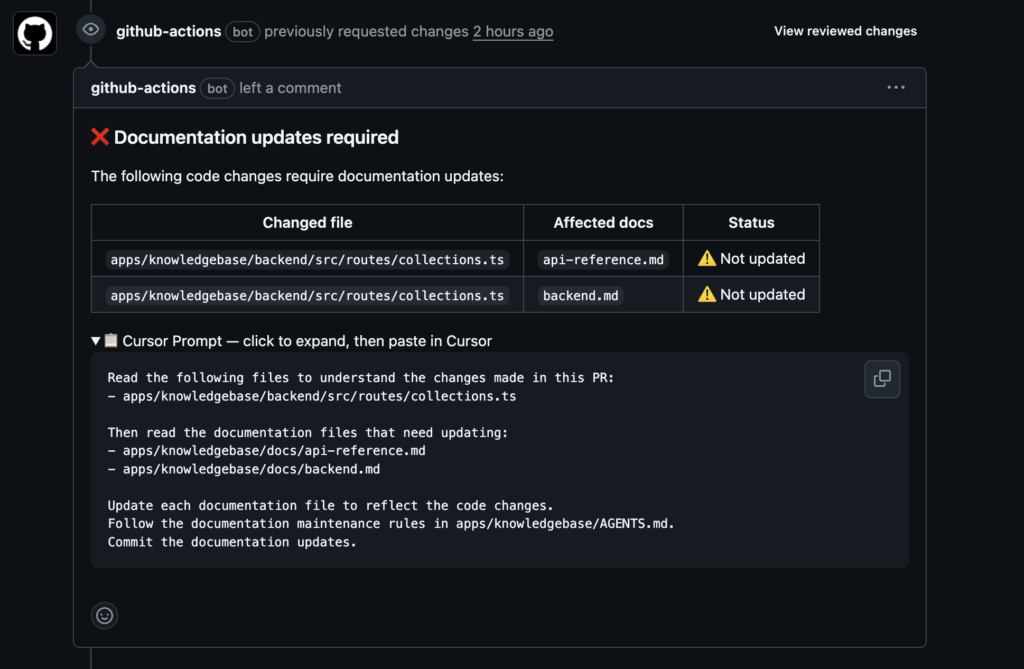
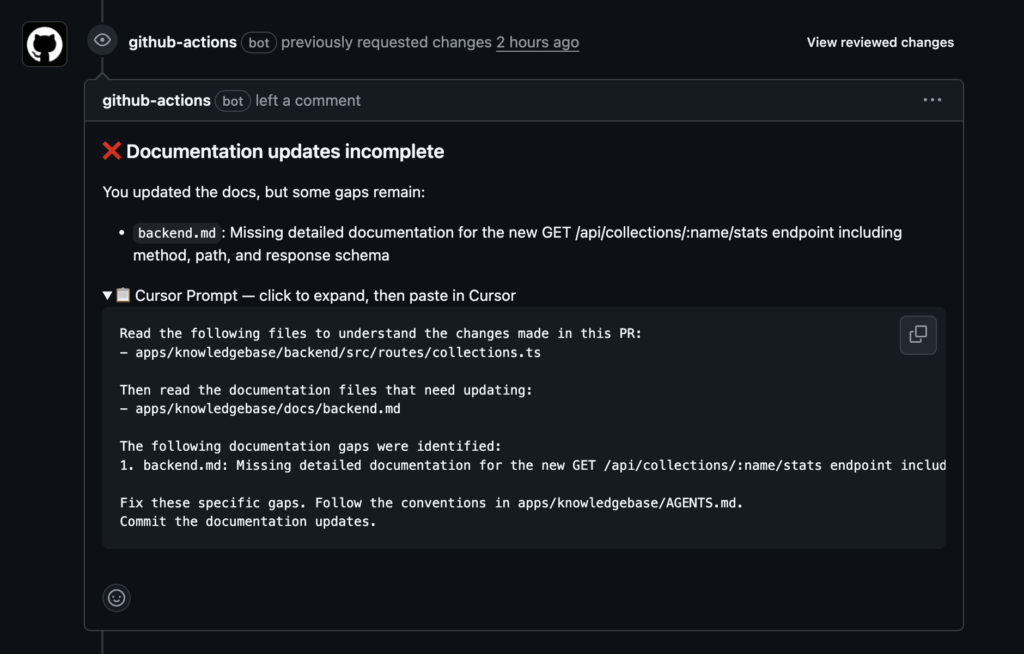
    3. If the relevant docs weren’t updated → fail the CI and post a review comment with exactly what to do
    4. If docs were updated → use AI to verify the updates actually cover the changes
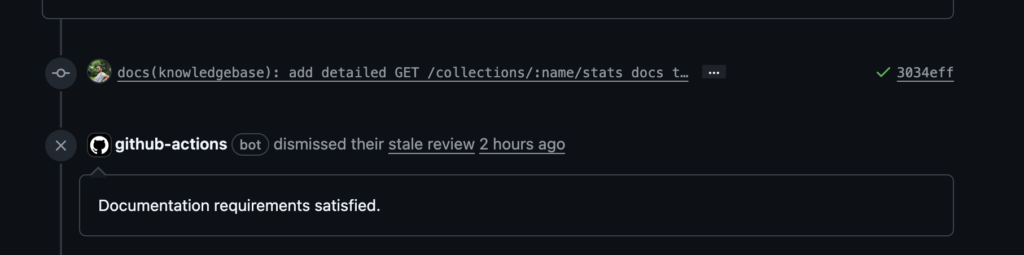
    5. Developer fixes the docs, pushes again → CI re-checks → repeat until it passes

    Phase 1: The Suggestion Bot (and Why I Scrapped It)

    My first attempt was gentler. I built a GitHub Actions workflow that would analyze PRs and suggest documentation updates as a regular PR comment. It used GPT-4.1 Mini to read the diffs, compare them against the current docs, and generate specific suggestions like “add this endpoint to api-reference.md.”

    It worked. The suggestions were good. But nobody acted on them.

    Turns out, optional suggestions in a PR comment are just noise. Developers read them, think “I’ll do that later,” and merge. The docs stay stale.

    Lesson learned: if you want docs to stay current, you need a gate, not a suggestion.

    Phase 2: The Docs Gate

    The rewrite changed three things:

    1. CI fails instead of suggesting. The workflow exits with code 1, which means the check shows as a red X. If your branch protection requires passing checks, the PR literally cannot merge.

    2. It posts a REQUEST_CHANGES review, not a comment. GitHub review comments have a “Resolve conversation” button. They show up in the “Files changed” tab. They count as blocking reviews. You can’t ignore them the way you ignore a bot comment.

    3. It generates a Cursor prompt, not doc content. Instead of the AI writing the docs (which produced mediocre results), it generates a prompt that the developer pastes into Cursor. Cursor has full IDE context — it reads the changed files, reads the existing docs, and updates them properly. The AI in CI just detects the gap; the AI in the IDE fixes it.

    How It Works Under the Hood

    The system has four TypeScript modules running on Bun:

    File Classifier — A regex-based mapping from code paths to doc files. Routes map to the API reference. Services map to the backend docs. Schema changes map to the database docs. This is the cheapest possible detection — no AI needed, just pattern matching.

    const FILE_TO_DOC_MAPPINGS = [
      {
        pattern: /^apps\/knowledgebase\/backend\/src\/routes\/.+\.ts$/,
        docs: ["docs/api-reference.md", "docs/backend.md"],
      },
      {
        pattern: /^apps\/knowledgebase\/backend\/src\/db\/schema\.ts$/,
        docs: ["docs/database-schema.md"],
      },
      // ... more mappings
    ];
    

    LLM Verifier — When docs were updated, this module sends the code diffs + doc diffs to GPT-4.1 Mini and asks: “Do the documentation changes adequately cover the code changes?” It returns a pass/fail with specific gaps. This is a verification prompt, not a generation prompt — much cheaper and more reliable.

    Cursor Prompt Builder — Generates a developer-friendly prompt that lists exactly which files to read and which docs to update. For incomplete docs, it includes the specific gaps the AI found. The prompt references the repo’s own AGENTS.md rules so Cursor follows the project’s conventions.

    Main Orchestrator — Ties it all together with a decision tree:

    No doc-relevant code changed         → Pass
    Code changed, docs not touched       → Fail (no AI needed, free)
    Code changed, docs touched           → AI verifies quality
      AI says complete                   → Pass, dismiss previous review
      AI says incomplete                 → Fail with specific gaps
    

    The clever bit: when docs aren’t touched at all, the check fails without making any AI calls. It’s completely free. The AI only runs when docs were actually updated and need quality verification.

    The Cost Profile

    This was important to get right. Nobody wants a CI check that costs $5 per PR.

    PR scenarioDetection costVerification cost
    No doc changes neededFreeNone
    Docs not updated (most common failure)FreeNone
    Docs updated, < 2000 linesFree1 LLM call (~$0.01)
    Docs updated, 2000-5000 linesFreeN calls, chunked by doc
    Mega PR > 5000 linesFreeSkipped (file-touched check only)

    The typical case — a developer forgets to update docs — costs literally nothing. The AI only fires when there’s actual doc content to verify.

    What the Developer Sees

    When the check fails, the PR gets a review like this:

    The developer expands the prompt, pastes it into Cursor, and Cursor does the rest. Push, and the CI re-runs.

    Until the docs are updated.

    The GitHub Actions Workflow

    The whole thing runs in a single job:

    name: Docs Gate
    
    on:
      pull_request:
        types: [opened, synchronize, reopened]
        branches: [main]
    
    permissions:
      contents: read
      pull-requests: write
    
    jobs:
      check-docs:
        name: Check documentation
        runs-on: ubuntu-latest
        steps:
          - uses: actions/checkout@v4
          - uses: oven-sh/setup-bun@v2
          - run: bun install --frozen-lockfile
            working-directory: .github/scripts
          - run: bun run docs-gate.ts
            working-directory: .github/scripts
            env:
              GITHUB_TOKEN: ${{ secrets.GITHUB_TOKEN }}
              OPENAI_API_KEY: ${{ secrets.OPENAI_API_KEY }}
              GITHUB_REPOSITORY: ${{ github.repository }}
              PR_NUMBER: ${{ github.event.pull_request.number }}
    

    Setup: add OPENAI_API_KEY as a repo secret. That’s it. GITHUB_TOKEN is automatic.

    What I’d Do Differently

    Start with the gate, not the suggestion bot. I wasted a full iteration building a “nice” suggestion system that nobody used. The constraint (blocking merge) is what makes it work.

    The file classifier is the most important piece. Get the regex mappings right and everything else follows. Get them wrong and developers will learn to ignore false positives.

    Let the IDE AI write docs, not the CI AI. CI has limited context — just diffs and file contents. The IDE has the full codebase, language server, and developer intent. Use CI for detection, IDE for correction.

    Try It Yourself

    The entire implementation is open source. You can adapt it to any repo by:

    1. Writing a file classifier that matches your project’s code-to-docs mapping
    2. Pointing the Cursor prompt builder to your documentation conventions file
    3. Adding the workflow and an OpenAI API key

    The code lives in .github/scripts/ — four TypeScript files, about 500 lines total, running on Bun.

    If your team has the “docs are always out of date” problem, this fixes it. Not by generating docs for you, but by making it impossible to merge without them.


    The complete source code is available on GitHub: sarvesh-ghl/docs-gate. Fork it, customize the file classifier for your project, add an OpenAI API key, and you’re done.

    _If you’re interested in the implementation details or want to discuss adapting this for your stack, feel free to reach out._